Showing posts with label Termite Facts. Show all posts

How Worker Termites Feed the Colony

Termite Facts, Types of Termite, Termite Bait, Termite Control, Termite Treatment, termites pictures, worker termite, trophallaxis
It's a well known fact that worker termites feed the rest of the colony. Nature made it so that only the worker termite caste can digest timber or (timber products) by the use of symbiotic protozoa in their gut. The worker termites digest and then regurgitate the partly digested timber as a semi-liquid food for the other termite castes. Not only that, even the workers' excrete is eaten by other termite castes as it is high in cellulose content. This feeding by mouth and anus is technically known as trophallaxis.

Termite Facts, Types of Termite, Termite Bait, Termite Control, Termite Treatment, termites pictures, worker termite, trophallaxis
This finding has enabled modern termite control products to take advantage of the mutual feeding and regular grooming habits of termites, as a means to effectively eliminate the entire colony. Worker termites readily ingest the bait and transport it back to the colony nest to feed other termites. If sufficient workers ingest the bait and the queen is killed, then the collapse and death of the colony is highly probable.

The latest termite baiting system also takes advantage of the fact that worker termites cannibalise other dead termites. Therefore if the dead termites carry the bait material in their system, this will further hasten the demise of the colony.

Mothballs (Naphthalene) Do Not Repel Termites

Formosan termites may not worry about moth holes in their sweaters, but they are the first insects discovered to fumigate their nests with naphthalene. Scientists have discovered that termites, like the Formosan Subterranean Termite (Coptotermes formosanus), produce naphthalene - a hydrocarbon - which they apparently use as a defense against natural enemies, such as ants.

mothball naphthalene
People use the compound to rid human nests of carpet beetles and clothes moths, and to repel intruders such as bats and starlings. It also has antiseptic properties. However, naphthalene does not seem to bother Formosan termites, says urban entomologist Gregg Henderson, Ph.D., and his postdoctoral researcher Jian Chen of Louisiana State University Agricultural Center in Baton Rouge. In fact, they introduce the chemical as they construct their nests. And the Agricultural Center researchers have developed a method of using these unique gases to indicate the presence of termites.

A termite nest is a closed system which protects the termites in a microclimate that is controlled and different from that of the surrounding environment, Henderson says. As a soil-dwelling creature, Henderson notes, the termites confront many adversaries such as ants, fungus, bacteria, and nematodes. He believes that fumigating the nest with naphthalene and other volatile compounds may play an important role in inhibiting microorganisms and invertebrate invaders in the nest.

Henderson and his postdoctoral researcher Jian Chen found this unusual chemical in termite nests collected from colonies infesting houses and trees in New Orleans and Lake Charles, La. But the source of the naphthalene remains a mystery. Although Henderson admits that it may be possible for some animals to make naphthalene, he points out that there is no direct evidence of naphthalene being made by any animal or microorganism. Since termites use soil, masticated wood, and excrement to make their nests, one possible source is in the processed food of the termites or the soil, Henderson speculates. Another possible origin, he says, is that microbes are making the naphthalene by acting on material in the termite nest, the gut, or on the food.

Jian Chen from Louisiana State University and colleagues discovered that the termites incorporate naphthalene in their underground nests, which they build by cementing together soil and masticated wood with their saliva and excrement. In every kilogram of nest material, there was between 50 and 200 micrograms of naphthalene.

At these concentrations, the researchers demonstrated that Red Fire Ants (Solenopsis invicta), one of the termite’s main predators, become paralysed, and that fungal growth is inhibited, but even at these concentration levels the gas had no visible effect on the termites.

As a fumigant naphthalene is ideal for termite nests, vaporising easily to permeate the complex system of tunnels. But naphthalene may not be limited to defence. The researchers also showed that soldier termites follow trails of dilute naphthalene, indicating a possible use in the coordination of colony behaviour.

The presence of naphthalene in C. formosanus nests is quite remarkable. Tar, coal, petroleum, and the products of partial combustion of organic matter, were once thought to be the only sources of naphthalene in nature. These termite nests now join magnolia flowers and the forehead of male White-tailed Deer (Odocoileus virginianus) as unusual places for naphthalene to be found. Exactly how the termites obtain naphthalene, or whether they manufacture it themselves, is unknown.

References
Chen, J., Henderson, G., Grimm, C.C., Lloyd, S.W. & Laine, R.A., 1998. Termites fumigate their nests with naphthalene. Nature 392: 558--559.

Formosan Subterranean Termite - Coptotermes Formosanus Species

The Formosan subterranean termite (Coptotermes formosanus) is an invasive species of termite. It has been transported worldwide from its native range in southern China to Formosa (Taiwan, where it gets its name) and Japan. In the 20th century it became established in South Africa, Hawaii and in the continental United States.

Termites Pictures,Coptotermes, Formosan Termite, Subterranean Termite, Termite Facts, Termites Pictures, Types of Termite
The Formosan subterranean termite is often nicknamed the super-termite because of its destructive habits. This is because of the large size of its colonies, and the termites' ability to consume wood at a rapid rate. A single colony may contain several million (compared with several hundred thousand termites for other subterranean termite species) that forage up to 300 feet (100 m) in soil. A mature Formosan colony can consume as much as 13 ounces of wood a day (ca. 400 g) and severely damage a structure in as little as three months. Because of its population size and foraging range, the presence of colonies poses serious threats to nearby structures. Once established, Formosan subterranean termite has never been eradicated from an area.

Formosan subterranean termites infest a wide variety of structures (including boats and high-rise condominiums) and can damage trees. In the United States it is responsible for tremendous property damage resulting in large treatment and repair costs.

The Formosan subterranean termite acquired its name because it was first described in Taiwan in the early 20th century, but C. formosanus is probably endemic to southern China. This destructive species was apparently transported to Japan prior to the 17th century and to Hawaii in the late 19th century (Su and Tamashiro 1987). By the 1950s, it was reported in South Africa and Sri Lanka. During the 1960s it was found in Texas, Louisiana, and South Carolina. In 1980, a well-established colony was thriving in a condominium in Hallandale Beach, Florida. The Formosan termite is rarely found north of 35° north latitude. They have been reported from eleven states including: Alabama, California, Florida, Georgia, Hawaii, Louisiana, Mississippi, North Carolina, South Carolina, Tennessee, and Texas. Their distribution will probably continue to be restricted to southern areas because their eggs will not hatch below about 20°C (68 °F).

Termite Vs Ant Video (German)


A very professional documentary video on termites and their nemesis the ants. For over 200 million years, ants have been attacking and foraging termite colonies for food. Too bad the video is in german but still the captured event is very informative and fascinating.

Termite Queen Video


A high performance Queen termite can lay up to 30,000 eggs a day. That's 900,000 eggs a month or 10,950,000 eggs a year. Assuming a lifespan of up to 15 years, a Queen can lay a whopping 164,250,000 eggs.

Termites in the Wild Video


Sir David Attenborough wanders into the wonderful world of termites in South Africa to better understand the ways in which these amazing animals ventilate their homes, breed and fight for survival. A brilliant video from BBC insect and wildlife show 'Life in the Undergrowth'.

Termite Life Cycle

Termites Pictures, Termite life cycle,Termite cycle, Termite Facts, Termite queen, Termites Pictures, Types of Termite, Winged Termites
The life cycle of the termite begin with a mating flight, wherein established colonies experience winged reproductive males and females leaving, and swarming and then going on to procreate. After fertilization, winged termites land and shed their wings, going on to form new colonies. These insects then become the king or queen termites of their newly-established colonies. The queen and king termites are the center of the termite life cycle and are solely responsible for reproduction.

Termite Eggs
Termites Pictures, termite eggs,Termite cycle, Termite Facts, Termite queen, Termites Pictures, Types of Termite, Winged Termites
Termite eggs resemble caviar but much smaller: they are small, white, translucent and ovoid in shape. A new queen's first clutch will contain approximately two dozens eggs. Each subsequent laying will contain smaller egg quantities, although termite queens can lay eggs throughout their incredibly long life spans. Termite eggs are large enough to be visible to the naked eye. However, they are laid in sheltered locations such as wall interiors or underground nests and are rarely seen by humans.


Termite Larvae
Termites Pictures, termite larvae,Termite cycle, Termite Facts, Termite queen, Termites Pictures, Types of Termite, Winged Termites
Termite larvae typically hatch within a few weeks. They are approximately the same size as the eggs from which they hatched and are immediately tended to by worker termites. Unlike insects such as the carpet beetle, termite larvae do not directly cause damage to infested homes. However, they comprise a large part of a termite colony and require constant feeding; worker termites feed on wood in order to feed the colony's larvae. Similar to other insect young, termite larvae go through a series of molts, during which they shed their skins, before developing into mature adults. Typically, termite larvae molt five times before becoming adults. From the larval stage, termite larvae can evolve into members of any of the colony's castes. Larvae are cared for by moving them from location to location in order to avoid intolerable temperatures. The colonies themselves are designed to ensure that delivery of food to larvae and relocation of larvae are possible.

Termite Caste
Over the course of several molts, these larvae grow to assume the role of one of the three termite colony castes: workers, soldiers and reproductive termite, also known as alates. Each caste has a distinctly different physical appearance.

Termites Pictures, termite worker,Termite cycle, Termite Facts, Termite queen, Termites Pictures, Types of Termite, Winged Termites
Workers are sexually and developmentally immature insects that are responsible for constructing tunnels and chambers as well as feeding and grooming other termite castes. Their cuticle is unpigmented and not hardened, therefore the animals are confined to a dark and moist environment. Workers build the nest and galleries, they fetch food, care for the brood and feed reproductives and soldiers. The worker’s life span is one to two years.
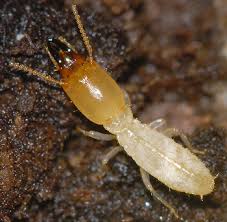
Termites Pictures, termite soldier,Termite cycle, Termite Facts, Termite queen, Termites Pictures, Types of Termite, Winged Termites
Soldier termites are yellow-brown in color, with dramatically-enlarged heads and mandibles. These are useful in combat but render warriors incapable of feeding themselves, they have to be fed by workers. Soldiers are like the workers - sterile, wingless and blind males and females with an unpigmented, unsclerotized cuticle. Soldiers defend their colony from intruders by the use of powerful jaws and/or by ejecting a white sticky repellent from an opening on their head. Usually the number of soldiers is much smaller than the number of workers. Soldiers can be mandibulate or nasute, depending on the species. Therefore soldiers can be used for the identification of termite species. The life span of the soldiers is one to two years.

The reproductive possess compound eyes and are more or less brown due to their sclerotized cuticle. Developing reproductives have wing buds, wings or wing stumps. Reproductives can be further divided into:
Termites Pictures, termite alates,Termite cycle, Termite Facts, Termite queen, Termites Pictures, Types of Termite, Winged Termites
* Alates, the young winged reproductives of both sexes. From time to time about 100 to 1000 alates leave the colony for a mating and colonising flight. After mating a pair settles down at a suitable site like a rotting scar on a tree in order to establish a new colony.
Termites Pictures, termite de-alates,Termite cycle, Termite Facts, Termite queen, Termites Pictures, Types of Termite, Winged Termites
* De-alates, alates that cast their wings after the colonising flight and successively turn into queens and kings. Initially only a few eggs are laid and brought up by a female de-alate. As the number of individuals in the colony grows, the more workers are available to help the young queen to care for the brood. After three to five years the number of individuals is already so large, that the colony of a pest species can turn into the damaging stage.
Termites Pictures, termite king, termite queen,Termite cycle, Termite Facts, Termite queen, Termites Pictures, Types of Termite, Winged Termites
* Queen and king, which are the main reproductive individuals in a colony. Once there are many workers to help the queen, her only job is to produce a tremendous number of offspring. A large queen may lay more than 1000 eggs per day. The life span of a queen can be as much as 50 years.
Termites Pictures, termite neotenic,Termite cycle, Termite Facts, Termite queen, Termites Pictures, Types of Termite, Winged Termites
* Neotenics assist the queen in laying eggs, once her productivity decreases. When the queen has died or deteriorated, one of the neotenics takes her place. That is the reason why the removal of a queen from her colony does not necessarily mean the end of the colony.

Although it is not clear how larvae are relegated to a certain caste, some research has indicated that maturity and the overall needs of the colony may dictate caste assignment. In fact, research has indicated that castes in the termite life cycle are not rigidly set, as termites belonging to one caste may develop into another caste if the colony requires it. Soldiers, also referred to as intercastes might turn into workers or even into reproductives, if there is a shortage of individuals of other castes. This process is controlled by pheromones.

Types of Termite

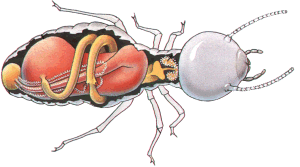
Termites have thrived on our planet for the past 250 million years. Technically, there are three major types of terrestrial termites in the United States: drywood; subterranean (ground); and Formosan. All types of termites survive by ingesting cellulose, found in wood and wood products. Termites live within highly organized social colonies much like their biggest adversary, the ant.

Drywood
Drywood termites like to live above the soil. They are most typically found in wooden structures such as furniture, trees, and house walls and floors. Once these types of termites have established their domain they are difficult to eradicate. They are hard to detect until they have already caused substantial damage because oftentimes, the damage is not visibly apparent from the outside. As they eat away at wood they weaken the structure of the object they are devouring. These colonies eat wood 24 hours a day, so they can cause tremendous damage if unchecked. But unfortunately, this damage is incredibly difficult to detect early on. Even trained professionals often struggle to discover their entry point in order to eradicate an infestation of drywood termites.

The drywood termite is especially dangerous because these types of termites can have thousands of members in a single colony. They do not just eat wood, either. They are known to also eat through wallpaper, plastic, and even plant based fabrics. Because they prefer to live above the soil they do not require moisture like some other types of termites. For this reason, they can build colonies away from the soil, in nests and tunnels burrowed into trees, homes and other buildings.


Formosan
The Formosan termite is considered the most destructive of all types. It is actually labeled by some as one of the types of termites that fall under the subterranean category. Formosan colonies can be hundreds of feet long and have thousands of members. Their members are classified into three distinct types, each of which performs a specific function in the colony. There are workers, soldiers, and reproductives (kings and queens). These particular types of termites are so powerful in their destructive ability that they can actually destroy a home's foundation within only a few months. It is critical to get help dealing with these types of termites as quickly as possible.

Formosan termites are nicknamed the "super termite" by some because of their awesome destructive ability and also due to their rapid reproductive process. They are known to eat wood, plastic and even metal, and their queens can lay hundreds of eggs or more in a single day. They do great damage by eating through a home's walls. One telling sign of a Formosan termite infestation is a bulging wall. These types of termites can devour more material more quickly than other types, so it is critical to respond quickly by consulting an expert as soon as you suspect an infestation.


Subterranean
Subterranean termites have the largest colonies of all species. Their colonies can actually number into the millions, incredibly enough. Similar to the Formosan termite, these types of termites eat wood, plastic, wallpaper, and fabric made out of plant materials. They are dependent upon the soil for survival. They prefer to live underground or in damp places like rotted trees. Every spring groups of these types of termites fly off to start new colonies. They are known to eat through almost anything, including plastic pipes, subflooring, insulation, and many other objects.

Subterranean termites are known simply as the ground termite in some circles. They make tunnels up to the ground from their colonies in order to reach their food. These tunnels can be a sign of termite activity for these types of termites.

This broad category includes some subcategories that some experts prefer to divide them into because of certain varying geographical boundaries and specific characteristics each subgroup displays. These common group designations are eastern, western, and desert subterranean termites. Each of these three types can be studied independently for its particular traits, but each of these types of termites is considered a pest and all of them are extremely destructive to homes.

Subterranean Termite Reticulitermis Flavipes (Kollar)

Termites Pictures, Subterranean termite Reticulitermis flavipes (Kollar),Subterranean Termite, Termite Facts, Types of Termite
The subterranean termite Reticulitermis flavipes (Kollar) is probably the most destructive and widely distributed species in North America. This species has acclimatized to southern Ontario to such a degree that 27 municipalities report some degree of infestation. Subterranean termites are social insects, feeding on cellulose and living in colonies in the soil. These colonies are close to moisture, and can be readily relocated due to temperature or other environmental changes. Termites travel through soil, in wood itself, or through shelter tubes.

In the termite colony there are generally several generations present. The colony is made up of several castes (forms) (larvae, nymphs, secondary and primary reproductives, soldiers and workers), who carry out specific duties or functions. The female reproductives may lay thousands of eggs. These eggs hatch and pass through an immature stage (larvae) before finally differentiating into either a worker, soldier or reproductive caste.

Termites Pictures, Subterranean termite life cycle,Subterranean Termite, Termite Facts, Types of Termite
The primary female reproductive (the queen), is very rarely found in Ontario, whereas secondary reproductives in the colony carry on extensive reproduction. The two wingless non-reproductive castes consist of the soldiers and workers. The soldiers defend the colony from outside attack, while the workers carry out all duties except defence and reproduction. For example, the workers feed the reproductives, larvae and soldiers, care for the eggs, and construct tunnels and shelter tubes. The soldier caste consists of sterile adults with large heads and pincher-like mouth parts. These soldiers make up 2-3 % of the total colony.

There are three known methods by which a new termite colony may be established:
(1) The first method, common in the warmer climates of the southern United States, is called swarming. This occurs usually in spring, when large numbers of winged primary reproductives (alates) emerge from a colony, fly a very short distance, mate and then establish a new colony. Although alates are found in Ontario, rarely do they swarm.
(2) The second method is called "budding". In this method, when a colony becomes sufficiently large, or a portion of a colony becomes separated from the main colony, new secondary reproductives are formed from larvae or nymphs and the nucleus of a new colony is established.
(3) The third method of dispersal is through infested wood or soil being transported to a new location. As few as 15-40 larvae or nymphs contained in the infested material may moult to become secondary reproductives and begin a new colony.

    The worker termites are white in colour and approximately 6mm (1/4 inch) in length. Their antennae are straight (not elbowed) and the body is not narrowed at the waist, which distinguish them from ants. They have chewing mouth parts and are responsible for foraging and feeding the dependent members of the colony. The hind gut of the worker contains protozoa (single-celled animals) which assist in breaking down cellulose into its component parts which are digestible by the termite. The worker termite causes the structural damages.

    Soldier termites are similar in size and colour to workers, but have an enlarged brownish coloured head with large modified mandibles (large biting jaws), used for defense.

    Termites have a very thin cuticle (skin) and are subject to rapid desiccation (drying out) if exposed to the environment outside their enclosed habitat. In order to maintain a highly controlled environment, termites must live in a closed system. Colonies in wood are always contained within an outside shell of cellulose material. In this way, they are protected from exposure to the outside.

    Often shelter tubes constructed of soil particles cemented together by excrement or secretions from the mouth are used to connect the outside soil to a building and for crossing a concrete or metallic portion in a structure. The presence of a shelter tube is generally the first physical evidence of a termite infestation.


    Article Source: http://EzineArticles.com/?expert=Gil_Strachan

    About Termite Control Blog

    This blog is created to share my experience with termite infestation. My home was first detected with termites in the kitchen area, below the kitchen sink where water dripped onto a carton box stored there. Later another spot in the storage room nearby got infested as well. The termite was identified as the Formosan Subterranean Coptotermes genus. I hope this blog will benefit you the reader, with valuable information on termites - the different types out there; their behaviour; how to detect, control and protect your property from damage. Equally important perhaps are lessons learned from my experience with Termite Control Companies and how effective their solutions are.

    Recent Termite Control Posts

      © Blogger templates Palm by Ourblogtemplates.com 2008

    Back to TOP